This article contains affiliate links: if you buy through them we may earn a commission, at no extra cost to you. Read our affiliate disclosure.
The anchor is down in a turquoise bay, lunch is cleared away and everyone is asking the same question: is the slide going up? Knowing how to install a yacht slide well is what turns that into a quick, calm job instead of an hour of tangled lines. This guide covers measuring, how yacht slides are built to attach, the setup steps on deck, safety once it’s up, and how to bring it down and store it.
Before you start: measure and pick the launch spot
Every inflatable yacht slide is sized by one number: the drop from the rail where it starts down to the waterline. Measure it at the exact spot you plan to use, because side decks, upper decks and the bow all sit at different heights.
Makers make this easy. FunAir will work from your yacht’s General Arrangement drawing or a short measuring guide, and Superyacht Inflatables has a form too. As a guide, Superyacht Inflatables suggests a 4 m slide for a 4.4–4.6 m rail and a 5 m slide for 4.6–5.4 m. FunAir’s Hanger Mini covers 2–3.5 m and the Hanger 4–6.5 m.
- Side deck: the classic spot for a hanging yacht slide, with strong points nearby to tie to.
- Top deck: the biggest ride, but a longer slide and more crew to rig it.
- Bow: popular on sailing yachts.
- Swim platform: lower and gentler; suits freestanding slides and smaller boats.
While you’re measuring, look at the water side too. The bottom of the slide needs open water with nothing underneath it, and the spot should be away from the tender garage and the swim ladder traffic.
How a yacht slide is built to attach
An inflatable yacht slide isn’t bolted on. It’s a heavy, stiff inflatable with reinforced D-rings or anchor points, and you tie lines from those points to strong points on the yacht. Knowing the parts makes the setup make sense.
Self-supporting, not hanging on the rails
Good designs carry their own shape and don’t press on the rails. FunAir’s slides sit 10–15 cm above them, and Superyacht Inflatables designs its slides not to damage hand rails or guard rails. Freestyle’s Cruiser Flex needs no leg support up to 14 m high, and its lifting anchors are rated at 1,000 kg breaking strength.
Lifting straps, nets and water
Most yacht slides come with a lifting bridle or crane straps to swing them into place, a no-jump net at the top, and high side walls. FunAir builds a water distribution system into every slide that runs off a standard hose bib, which keeps the surface wet and fast.
Swim-platform slides
Some slides skip the rails entirely. Freestyle’s Cruiser XS (3.23 m or 5 m high) stands on the swim platform or floats flush in the water on mooring ropes. On smaller boats, a drop-stitch slide like Slide Island ties to a swim platform or dock and is rated to 300 lb in slide mode.
Permanent, rigid slides that need holes drilled into the boat are a different job. That’s work for the builder or a yard, not a weekend project, and it’s not what this guide covers.
How to install a yacht slide, step by step
Your slide’s manual comes first; follow it wherever it differs from the steps below. This is the general routine most crews use for an inflatable yacht slide.
- Anchor and switch off. Set the anchor in calm, sheltered water and switch the engines off. Check the depth and the bottom where riders will land.
- Lay it out. Unroll the slide on a clear stretch of deck, away from sharp edges and cleats. Check the seams, valves and D-rings before you add air.
- Inflate. Use the pump the maker supplies (FunAir uses its own electric pump; Superyacht Inflatables includes one; SPECRAFT’s comes with a pump too). Inflate to the pressure the manual asks for, using a gauge if there is one.
- Lift and position. Attach the lifting bridle or crane straps and swing the slide into place, with crew guiding it by hand. The bottom should meet the water.
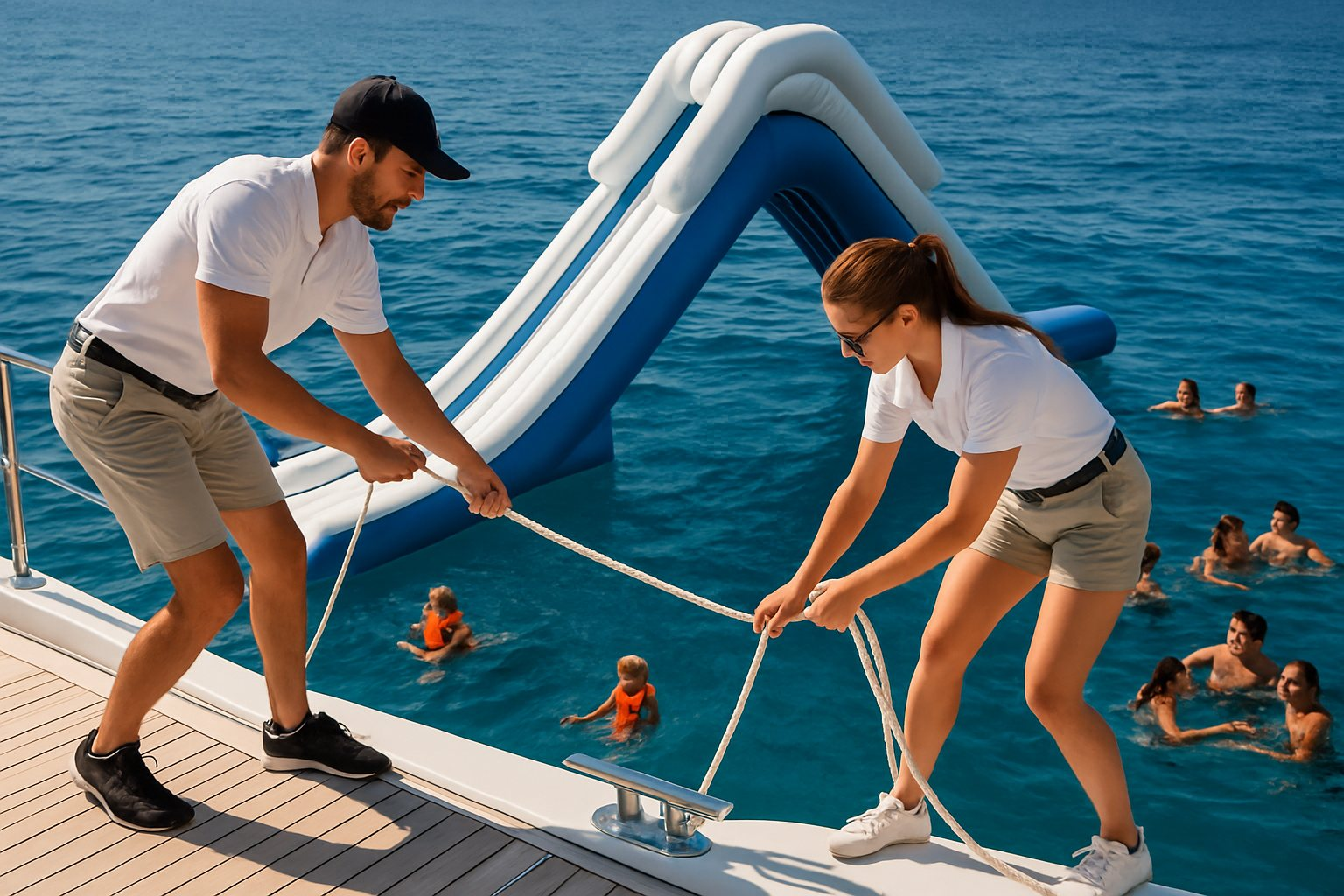
- Tie it off. Run lines from every anchor point the maker shows to strong points on the yacht. Make each line snug, check the slide sits square, and don’t load the rails unless the manual says so.
- Fit the stairs and net. Inflate any stair base or air-stair bladders, and make sure the no-jump net is up.
- Turn the water on. Connect the water system to the hose, or plan to splash buckets down it. A dry slide is slow and rubs skin.
- Test run. A confident adult swimmer goes first, then you recheck every line before guests line up.
How long it takes, and how many hands
Plan the crew before the guests are waiting. FunAir says under 15 minutes for its FunSize and Hanger Mini with one or two crew, about 20 minutes for a standard Hanger, and around an hour for a top-deck Riser. The first few times will take longer while everyone learns the routine.
Weight matters too. A 2.5 m Hanger Mini weighs about 97 kg and a 6 m Hanger about 158 kg, so lifting gear and several people are part of the job. The FunSize, at about 21.5 kg, is the one a small crew can handle easily.
Safety once the slide is up
- Engines off, anchor down the whole time anyone is sliding or swimming.
- One rider at a time. The next one goes only when the last has swum clear of the landing zone.
- Someone on watch at the top and someone watching the water. Supervise children closely.
- Life jackets on kids and weaker swimmers.
- Keep boats away. No tenders, jet skis or floats near the bottom of the slide.
- Watch the weather. Bring the slide in if the wind builds, a storm approaches or the current picks up. A big slide catches a lot of wind.
Sunscreen, drinking water and a little shade between runs keep everyone happy. For more, read our boat slide safety tips.
Taking it down and storing it
Bringing the slide in is the setup in reverse. Turn off the water, lift the slide back aboard with the straps, and rinse off the salt with fresh water. Let it dry before you deflate it and roll it into its bag or wrap; packing it wet invites mildew.
- Keep it out of the sun when it’s not in use.
- Check seams, D-rings and lines after each trip, and patch small leaks with the repair kit early.
- Plan the locker before you buy: a deflated 2.5 m Hanger Mini packs to about 120 x 100 x 70 cm.
Our boat slide maintenance guide has a full care routine.
Slides that make setup easy
If you don’t have a slide yet, these two are simple to rig without a crane plan. For the full range, from FunAir and Freestyle to stock-size slides with published prices, see the best inflatable yacht slides or browse our yacht slide guides.
SPECRAFT 16 ft Yacht Water Slide
- 16 x 5.3 x 11.5 ft
- Independent air chambers
- Pump included
Slide Island Boat Slide and Mat
- 10 ft 6 in drop-stitch slide
- 300 lb in slide mode
- Turns into a floating mat
SPECRAFT 16 ft Yacht Water Slide: a 16 x 5.3 x 11.5 ft PVC slide with safety sides and independent air chambers, and a pump the seller says inflates or deflates it in about five minutes. The seller doesn’t state a weight limit or how it rigs to the yacht, so it suits smaller yachts and houseboats with a lower deck, used gently.
Check the SPECRAFT 16 ft yacht slide price on Amazon
Slide Island Boat Slide and Mat: a 10 ft 6 in drop-stitch slide rated 300 lb in slide mode that turns into a floating mat. It suits a swim platform or dock rather than a high upper deck.
Check the Slide Island price on Amazon
Got a smaller boat? See the best inflatable boat slides.
Yacht slide installation questions
Can I install a yacht slide myself?
Yes, inflatable yacht slides are made to be rigged by the owner or crew, with no drilling. Smaller slides take one or two people; bigger ones need more hands and lifting straps. Rigid slides that bolt to the boat are a job for the builder or a yard.
What do I tie a yacht slide to?
Run lines from the slide’s reinforced D-rings or anchor points to strong points on the yacht, exactly as the manual shows. Good designs are self-supporting and don’t press on the rails; FunAir’s sit 10–15 cm above them.
How long does it take to set up a yacht slide?
FunAir says under 15 minutes for its FunSize and Hanger Mini with one or two crew, about 20 minutes for a standard Hanger and around an hour for a top-deck Riser. Expect your first few setups to take longer.
What size slide fits my yacht?
Measure from the rail where the slide will start down to the waterline. Superyacht Inflatables suggests a 4 m slide for a 4.4–4.6 m rail and a 5 m slide for 4.6–5.4 m; makers like FunAir will size it from your yacht’s drawings.
How deep should the water be under a yacht slide?
Follow the depth your slide’s manual asks for. Check the bottom for rocks or reef before anyone rides, and keep the landing zone clear of swimmers and boats.
Can I leave the slide up overnight?
It’s better not to. Wind can build after dark, a big slide catches a lot of it, and UV and salt wear the PVC. Bring it in, rinse it and let it dry when slide time is over.